From the Dugout to Goodbye: Peter’s Story

Not every funeral happens inside a chapel. Some unfold on baseball diamonds, under old trees, beside the log that once served as the very first “grandstand.” Some don’t even feel like funerals at all. They’re more like family picnics threaded with memory, music, and the quiet gravity of love.
That’s how it was for Peter Santos.
Peter was the kind of man who made decisions on his own terms. When faced with a cancer diagnosis, he chose to live what time remained with purpose, family, and an occasional beer at the pub, not in hospitals or waiting rooms. He didn’t want a fuss. He didn’t want money wasted. And he certainly didn’t want ceremony for ceremony’s sake.
And yet, somehow, his farewell was one of the most deeply ceremonial events I’ve been part of. Because when you get the heart right, the rest follows.
The Request That Meant Everything
One of the quiet but powerful requests Peter’s daughters, Bec and Claire, made was about fingerprints. They wanted to have imprints taken of their dad’s fingers so they could be made into jewellery – wearable reminders of his touch, his presence. This wasn’t a clinical task. It was an act of devotion.
We made arrangements around Peter’s cremation – a witness insertion with family present. Claire, Bec, their uncle Greg and his close friend stood together for that final, sacred moment. Behind the scenes, I worked to ensure the prints were taken with care and stored safely. Multiple versions, just in case. Different angles. Done not just efficiently, but gently, with reverence. Because it wasn’t about the fingerprint. It was about what it meant to hold on.
More Than Just a Service
The family said I helped “without them even knowing what they needed.” That might be one of the kindest things I’ve ever been told. Sometimes the real work isn’t the eulogy or the logistics. It’s in the unspoken. It’s placing tissues nearby before they’re asked for. Bringing water. Offering a pen when a memory strikes. Knowing when to speak and when to simply stand beside someone in silence.
And yes, sometimes it’s showing up at a baseball club in a jacket sharp enough to be called “suave,” which, I must say, I’ve been dining out on ever since.
A Resting Place with Meaning
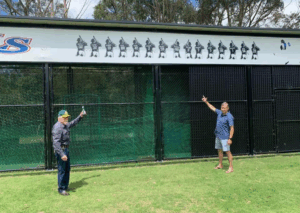
Peter’s ashes now rest beneath the log that once served as the very first seat at the Kissing Point Angels Baseball Club, the club he founded, the field he loved. His club number, “1,” is painted on the wall of the stadium, facing the pitch.
A quiet, permanent nod to where it all began. On the day of his memorial, players past and present came to pay their respects. They didn’t speak in eulogies. They spoke in stories. Coaches. Mates. Grown men who still carry Peter’s voice in their heads when they lace up their cleats.
There was a bugle player too, a nod to Peter’s army days and his love of brass. His daughters displayed his old bugle next to a poem, a photo, and a few of the “bits and bobs” that tell the story of a life. We stood in the sun that morning and said goodbye the way Peter would have wanted: honestly, humbly, and without making a fuss.
The Movie That Made It All Click
After everything was packed away, Bec wrote me a message. She’d just finished watching The Natural, her dad’s favourite film and said Peter carried himself like Robert Redford’s character: steady, humble, dignified, kind. I rewatched it that night.
And she’s right, it’s not a flashy movie. It’s a story of quiet brilliance. Of a man who shows up, does his best, and makes a mark that outlasts the scoreboard. That was Peter.
A Final Thought
I often say that being asked to lead a funeral is the highest honour. It’s being invited into a family’s most vulnerable moments and being trusted not just to hold the details, but to hold the feel.
For Peter, that meant fingerprints. A bugle. A patch of dirt beneath a log at a baseball field.
But mostly, it meant love, dressed down in jeans and sunscreen and folded camping chairs. The kind of love that doesn’t need to say much, because it’s already understood.

Greg Colby
Greg is a funeral director, celebrant, and founder of Your Choice Funerals. With 20+ years of supporting families through life’s most tender moments, Greg believes every farewell should feel true to the person it honours: personal, thoughtful and never rushed.